 Skip to content

When looking for a mortgage, almost everyone does the same:
we look at the interest rate and choose the lowest.
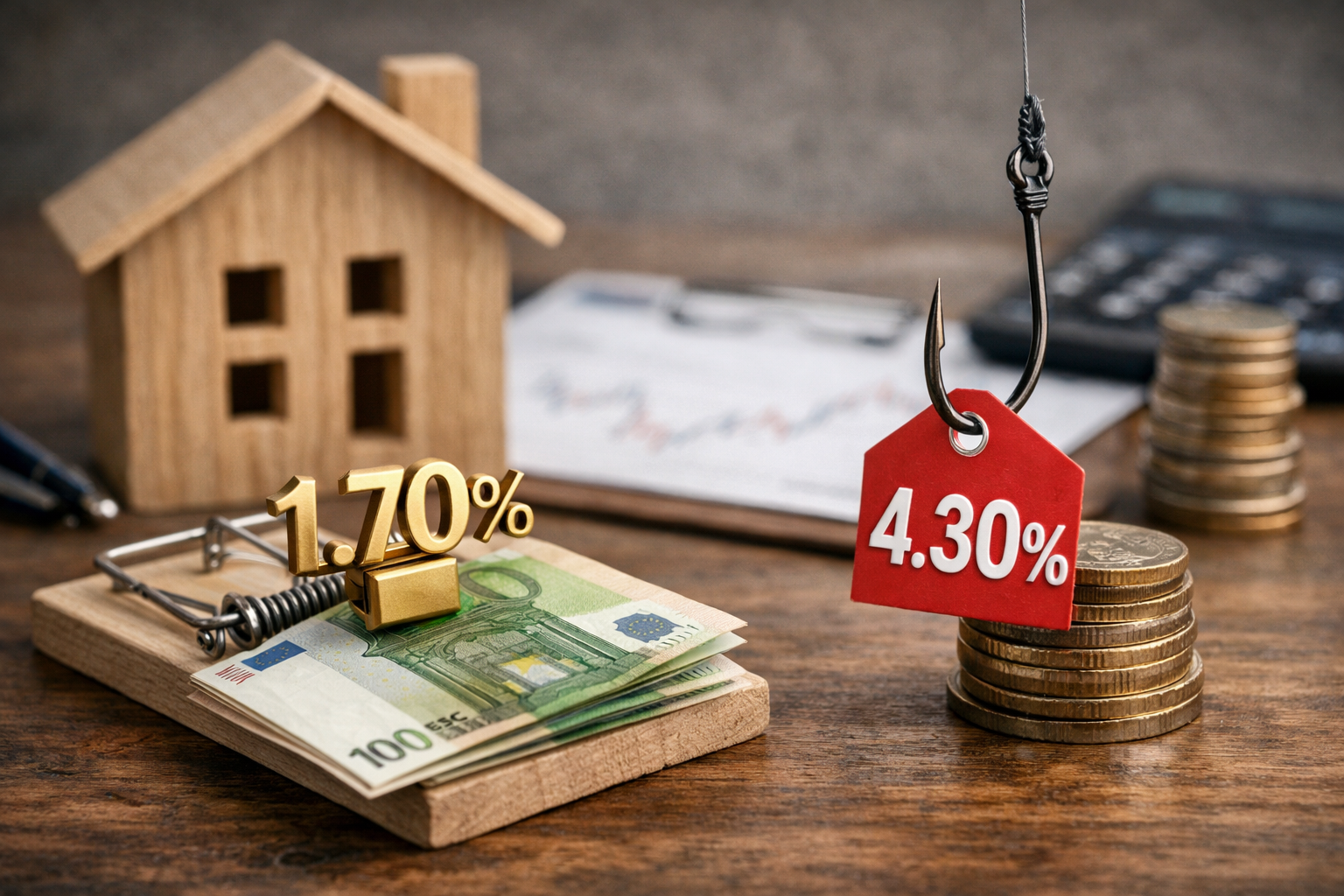
The problem is that the number you see in large print—the famous 1,70%, 1,80% or "from"— does not always reflect what you will actually pay..
The difference between a “cheap” mortgage and a very expensive one often lies in something many overlook: the jump from the TIN to the APR (TAE)..
Let's start with the basics: what is the TIN?
The TIN (Nominal Interest Rate) is the interest the bank applies to the money it lends you.
Put simply:
- It is the price of the loan.
- It is the figure most used in advertising,
- and it is the one that looks best in an advert.
But the TIN does not include many costs that you will actually pay.
That is why focusing only on it can lead to a mistaken conclusion.
So, what is the APR (TAE)?
The APR (Annual Percentage Rate) It tries to reflect the real cost of the mortgage..
Besides the TIN, it takes into account:
- Commissions,
- Payment method,
- And, above all, the economic impact of mandatory bindings,
which is why, when mortgages are compared, the APR (TAE) is the key figure..
The big jump: when a low TIN becomes a very high APR (TAE).
This is where the “trick” that many don’t see lies.
A realistic (and very common) example:
Imagine this offer:
- Fixed-rate mortgage advertised at 1.70% TIN.
- Amount: 250.000 €
- Term: 30 years
So far, everything seems excellent.
But to maintain that 1.70%, the bank requires:
- Life insurance for the entire life of the loan,
- Home insurance with a high premium,
- Payment protection insurance,
- Use of card with minimum spending,
- Salary domiciliation,
- Annual contribution to a pension plan.
When the real cost of all these products is added up...
➡️ Final APR (TAE): 4.30%
The advertised interest rate is 1.70%,
but the real cost of the mortgage more than doubles..
Another example: the same mortgage, without so many strings attached.
Now let’s see an alternative:
- Fixed-rate mortgage at 2.40% TIN.
- Fewer bindings,
- No expensive mandatory insurances,
- No imposed pension plans,
➡️ Final APR (TAE): 2.60%
Although the TIN is higher,
the mortgage is much cheaper in real terms..
Why this happens (and why it is not always well explained)
The bindings:
- Generate additional income for the bank,
- Are not perceived as “interest,”
- But and have a huge economic impact over the long term.
The problem is that:
- The cost of those products is not always correctly assessed,
- They are paid year after year,
- And often, it’s not easy to remove them without penalty.
The most common mistake when comparing mortgages
Is comparing only this:
- “This one is at 1.70%”
- “This one is at 2.40%”
And choosing the first.
That mistake can mean:
- Thousands of euros more in insurance,
- Less financial freedom,
- And a mortgage that seemed good… but was not.
What you should always do before signing
Before deciding on a mortgage, it is advisable to analyse:
- TINthe TIN, to know the base interest rate,
- APRthe APR (TAE), to understand the real cost,
- Which products are mandatory,
- How much those products cost annually,
- What happens if you decide to cancel them in the future.
This comprehensive analysis does not usually appear in advertisements, but it is the one that truly matters.
It is not mistrust, it is information
It is not about thinking “they want to deceive you”,
but about understanding that a mortgage is a complex product.
The nominal interest rate (TIN) catches the eye.
The APR (TAE) tells the truth.
And only when you understand the difference can you make a good decision.
That is why, at Hipotea we do not limit ourselves to negotiating a good interest rate for you.
We analyse and negotiate all the linked conditions, one by one, assessing their real cost and whether they really benefit you over time.
Because a mortgage is not just the interest rate you sign today,
but everything you will pay over the next 20 or 30 years.


