 Skip to content

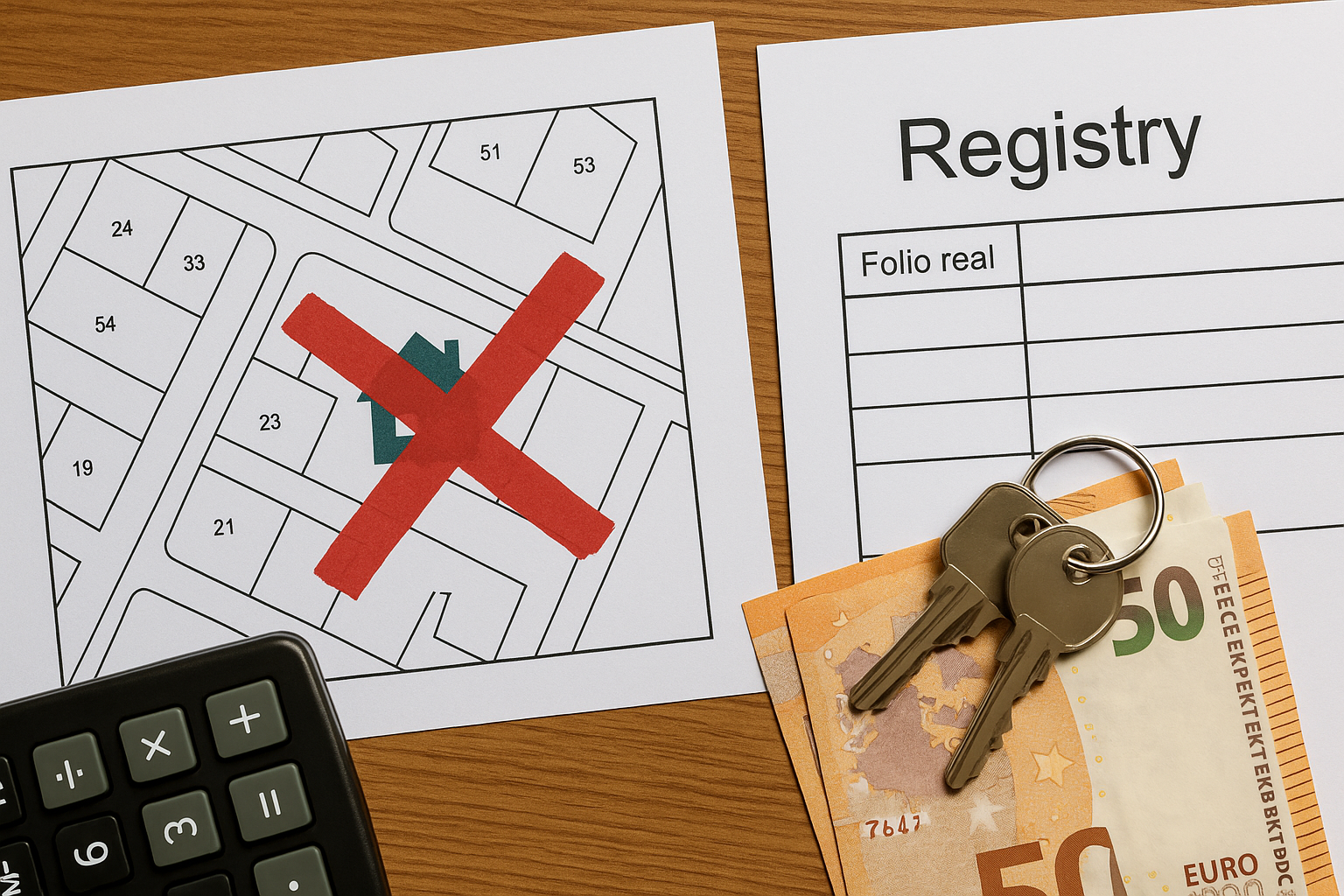
In the process of buying a home with mortgage financing, there is a detail many overlook which can delay, block, or even prevent a bank from approving the loan: when the data in the Cadastre and the Property Registry do not match.
At Hipotea Asesores we are seeing this increasingly. Differences that seem “insignificant” — a few more or fewer square metres, an undeclared extension, poorly defined boundaries — can become a genuine bottleneck when the appraiser or bank reviews the property.
In this article we explain what happens when Cadastre and Registry do not match, why it affects your mortgage, and how to avoid problems before signing.
1. What exactly is the problem?
Although many people believe that Cadastre and Registry are the same, they serve completely different functions:
Cadastre
An administrative and tax register: it records the surface area, use, cadastral reference, location, etc. It is mainly used for taxes such as the IBI (property tax).
Property Registry
The legal register that determines who the owner is, what encumbrances the property has, and what legally exists.
This is the register that banks use to assess the security of your mortgage.
What happens if they don’t match?
If the registered surface area does not match that of the Cadastre, if there are undeclared extensions, if the plot has different boundaries, or the physical reality does not correspond to what is registered...
→ The valuation may be compromised
→ The bank may halt the process
→ Or outright refuse the mortgage
Because for the bank, the guarantee must be clear and legally secure.
Why can these differences block a mortgage?
Law 5/2019 requires that the property be perfectly identified to constitute a mortgage loan.
And Law 13/2015 requires properties to have a georeferenced graphical representation, usually that of the Cadastre.
When this does not happen, three major problems arise:
1. The valuation can be "conditioned"
The appraiser may require additional documentation, ask for regularisation, or even be unable to value the entire property.
Without a valid valuation → no mortgage.
2. The bank can consider the property as “unidentified”
If what is registered does not match what the appraiser sees, the bank can halt the entire file.
Legally, the guarantee must be 100% clear.
3. Unregistered constructions = legal risk
Attics, extensions, enclosed porches, integrated storage rooms, swimming pools... If they don’t exist in the Registry:
→ they don’t count as collateral
→ they lower the valuation
→ they limit financing
→ they can make the operation unviable
What the regulations require to fix it
If there are significant differences between Cadastre and Registry, the law sets a process to regularise it:
Law 13/2015 and Mortgage Law (arts. 199 and 201)
They may require:
• topographical survey
• georeferenced graphical representation
• notification to neighbours
• Cadastre–Registry coordination
• registration size rectification
• a complete file if the difference exceeds approximately 10%
This involves time, costs and additional procedures.
Meanwhile, the mortgage remains suspended.
The real impact on the mortgage (what happens in practice)
From experience managing thousands of mortgages, these are the most common effects:
– Conditioned valuation
The bank cannot proceed until the discrepancy is resolved.
– Delays that jeopardise contract dates
Especially if a deposit has been paid or there is a notarial agreement.
– Unexpected costs
Surveyor, rectification deed, registry update...
– Deals that fall through
When regularisation is not feasible or would take too long.
– Feeling of insecurity in the buyer
Many clients believe that “someone has deceived them”, when it is simply a case of outdated documentation that has not been properly updated.
How to prevent this from ruining your mortgage
(Process recommended by Hipotea Advisors)
To minimise risks, we always recommend reviewing the property before starting the process with the banks. These are the key steps:
1. Initial documentation check
Before signing the deposit contract:
• Land registry simple note
• Descriptive and graphic cadastral certificate
• Previous deeds
• Plans or sketches
• Verification of actual surface area versus registered surface area
2. Identification of discrepancies
If there are relevant differences (>5–10%), ask the estate agent or seller how they plan to resolve it from the outset.
3. Support in regularisation
To correct discrepancies, in some cases it will be necessary to consult surveyors, architects, conveyancing lawyers...
At Hipotea Advisors, if we manage the mortgage, we also coordinate everything to ensure it is done correctly.
4. Alternatives if there is no time
We propose viable options to save the transaction:
• Contractually agreed delay
• Partial signing
• Changing to a more flexible bank
• Restructuring of the valuation
5. Clear communication
Insist that they explain why it is happening, the consequences and the solutions. Transparency will provide the trust you need in these cases and avoid tensions in the process.
6. Which discrepancies worry banks the most?
• Different built surface area
• Unregistered annexes (attics, porches, rooms)
• Undeclared changes of use
• Unregistered old constructions
• Plots with disputed boundaries
• Buildings outside planning regulations
These situations can lead to limited or unsuitable valuations.
7. Conclusion: a silent problem, but entirely avoidable
Differences between the Cadastre and the Land Registry are not a mere technical detail.
They can slow down a purchase, halt a mortgage or increase the cost of a transaction.
The good news is that, if reviewed in time, most are resolved without major complications.
At Hipotea Advisors we offer a comprehensive legal-cadastral review so the buyer arrives at signing with peace of mind that nothing will go wrong at the last moment.
A good mortgage always starts with a property well documented.


