Skip to content

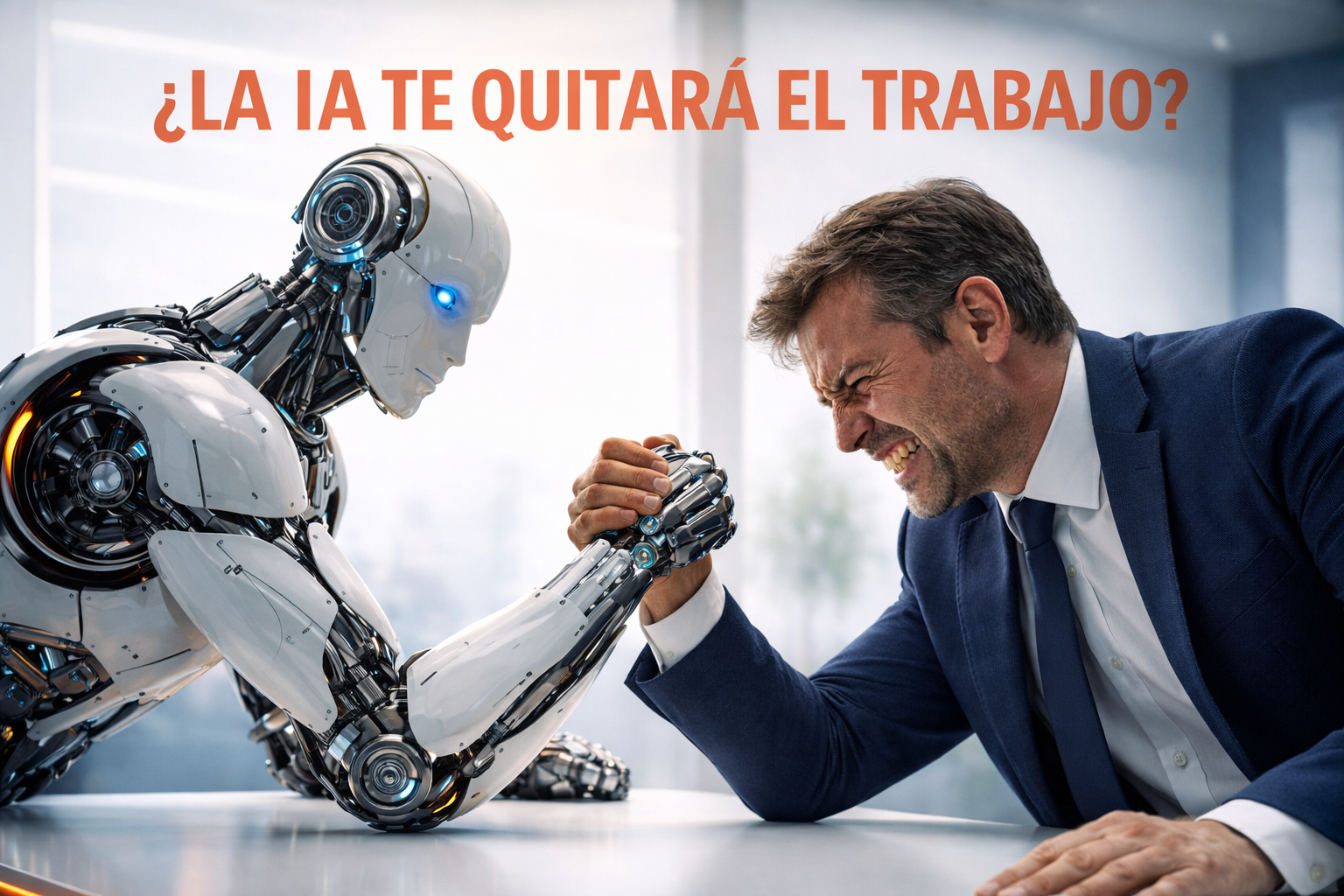
For years the message was relatively reassuring:
“AI only automates repetitive tasks.”
That message is no longer sufficient.
Generative artificial intelligence not only drafts texts or classifies documents. Today:
- It oversees processes.
- It detects errors better than humans in certain environments.
- It makes operational decisions.
- It manages complex conversations.
- It executes automated sales.
- It coordinates autonomous agents working tirelessly.
The question is no longer whether AI will affect employment.
The question is how much, how fast, and who.
And the speed is increasing.
What the most important studies say about employment and AI
Projected job destruction
- According to the World Economic ForumAI could displace up to 92 million jobs by 2030..
- A widely cited report attributed to Goldman Sachs estimated that, with AI development, up to 300 million jobs worldwide could be affected or degraded in the medium term.
- A market analysis indicates that AI could displace approximately 10.4 million jobs in the United States by 2030,equivalent to about 6.1% of current employment in that country..
- A global index suggests that around 980 million jobs worldwide could face a high risk of labour disruption in the coming years due to AI,particularly in tasks susceptible to automation.
These figures are not alarmist without basis: they are quantitative projections supported by organisations experienced in labour market analysis.
Why these predictions matter
These projections do not mean “2030 will be the apocalypse for employment”:
- Many of those roles will not disappear completely,but rather will change radically or be redistributed into tasks involving AI.
- Some studies forecast net job destruction, while others discuss expanding markets due to emerging new functions.
- But there is consensus on a key point: AI will severely transform the nature of existing occupations and reduce demand for repetitive and structured tasks,, which translates into millions of workers facing forced career changes or retraining.
Job destruction is already a fact.
We are not talking theory.
In recent years we have seen clear examples of massive job reductions in large companies while accelerating efficiency and automation:
- Amazon carried out cuts exceeding 16,000 corporate employees within reorganisation processes aimed at efficiency.
- Meta laid off tens of thousands of workers in several waves while redirecting its focus towards automation and technology.
- Google made significant cuts in various divisions alongside its investment in AI.
- Salesforce reduced staff while enhancing its products based on artificial intelligence.
- Klarna publicly acknowledged that using AI in customer service allowed for staff reductions.
- IBM announced that some of its administrative positions could be replaced through automation.
Not all layoffs are exclusively due to AI.
But AI is the tool that enables doing the same or more with a smaller workforce.
And when a company finds it can produce better with fewer people, competitive pressure pushes in that direction.
The real evolution: from tool to partial substitute
AI has gone through three very clear phases:
- Tool that assists.
- Co-pilot that proposes decisions.
- Agent that executes and optimises complete processes.
Today there are systems capable of:
- Managing complete sales pipelines.
- Prioritising leads according to probability of closing.
- Adjusting sales pitches in real time.
- Reviewing contracts with high precision.
- Analysing preliminary financial risks.
- Detecting medical anomalies in diagnostic tests.
We are no longer just talking about repetitive tasks.
We are talking about supervision, quality control and exception management.
Professions with highest risk (from most to less exposed)
Very high risk
Roles where the main value lies in processing structured information and applying rules.
Basic customer service
- Scripted call centres
- First-level technical support
- Management of frequent incidents
Office administration
- Data entry and validation
- Repetitive document management
- Standard reconciliations and reporting
Routine quality control
- Checklist reviews
- Formal audits
- Basic compliance verification
Here AI not only executes.
It also reviews and corrects.
High risk
Roles where AI even begins to compete in decision-making.
Supervisors of repeatable processes
- Ticket coordinators
- Workload management
- Time and SLA control
Financial and banking operations
- Junior risk analysts
- Document processing
- Preliminary validations
Operational digital marketing
- Mass campaign creation
- Automatic optimisation
- Data-driven segmentation
Structured sales
AI agents can now:
- Manage follow-ups.
- Personalise proposals.
- Adapt communication.
- Never forget a client.
- Work 24/7.
Much of the intermediate sales process can be automated.
Medium risk
Professions where AI competes technically, but relevant human layers exist.
Legal documentation
- Initial drafts
- Clause comparison
- Basic due diligence
Analytical consulting
- Preliminary modelling
- Initial data analysis
Diagnostic imaging in healthcare
In controlled environments, AI already matches or surpasses specialists in specific tasks.
But the complete medical act is not just pattern detection.
Lower risk (but not nonexistent)
Physical trades
- Installers
- Technicians
- Manual professions
Professions requiring deep trust
- Psychology
- Strategic negotiation
- Lifelong financial support
They are not immune, but their core value is harder to fully automate.
The invisible effect: fewer entry points
One of the most serious impacts is the reduction of junior positions.
Where a young profile used to learn by doing repetitive tasks, and now AI performs those tasks, companies need fewer entry-level profiles.
The risk is not only losing a job.
It is also not obtaining one. And here, younger generations seeking their first job will face greater difficulties.
The scenario ahead
In the coming years we will see:
- Autonomous agents managing complete processes.
- AI supervising other AI.
- Reduction of intermediate layers.
- Greater concentration of value in strategic profiles.
- Automation of operational decisions.
AI will become increasingly humanlike in behaviour.
It will manage emotions.
It will simulate empathy.
It will learn from context.
And in many tasks, it will decide better than us.
So, what will remain when everything is AI?
Here lies the key point.
It’s not about saying AI won’t appear empathetic.
It’s about understanding what we will prefer.
In important decisions — health, money, family, future — many people will still want to:
- Look someone in the eye.
- Feel shared responsibility.
- Perceive that the adviser has also experienced uncertainty.
- Hear a “I would do this in your place” born from real experience.
A machine can analyse millions of data points.
But it has not experienced fear.
It has not felt real pressure.
It has not signed contracts with doubts.
It has not been through a personal crisis.
It can simulate understanding.
But it cannot have truly experienced it.
And in life-changing decisions, that difference matters.
Just as when we finish work we prefer meeting a friend over a robot, even if it always tells the same bad jokes. We don’t seek perfection. We seek connection.
When everything is AI, AI will cease to be distinctive.
What will be distinctive again is humanity.
Anticipation is the only real advantage
Our CEO, Antonio López, summarises it clearly:
“Those who do not adapt, become extinct.
Those who adapt, survive.
Those who anticipate, lead.”
Adapting today means using AI.
Surviving means integrating it into your work.
Leading means anticipating and creating something better, new and different where AI is an ally, not an enemy.
If you can design models, services or proposals that do not yet exist, AI will work in your favour.
The more creative you are in your work, the more you will not only guarantee your job but may become the leader in your sector.
Because artificial intelligence optimises what already exists.
But it cannot anticipate human imagination that creates something before there is a pattern to copy.
There, the advantage is still yours.
The model applied at Hipotea
At Hipotea, artificial intelligence does not replace people. It empowers them.
Technology speeds up:
- obtaining and analysing documentation,
- comparisons,
- simulations,
- time reduction.
But when someone makes a financial decision that could shape their future, they need more than mathematical accuracy.
They need clarity.
They need support.
They need trust and empathy.
Therefore, we sum it up in the words of our CEO, Antonio López: “technology to speed up and people to captivate”