Skip to content


The Spanish property market during 2025 was not explained solely by the evolution of prices or interest rates. To truly understand what happened —and what we learnt for 2026— it was crucial to analyse who bought property in Spain throughout 2025.
The most recent data shows that 2025 consolidated a structural change in the buyer profile: fewer first-time buyers, more owners changing residence, more investors and an increasingly significant share of foreign buyers. In this article we provide a complete and now final portrait of the buyer profile in 2025, with real figures, clear analysis and practical conclusions.
A KEY IDEA TO START WITH
In 2025, buying property in Spain was no longer predominantly a first purchase.
The market was largely supported by buyers with prior assets, financial capacity and more strategic decisions.
1. REGULAR HOME BUYER: THE MAJORITY PROFILE IN 2025
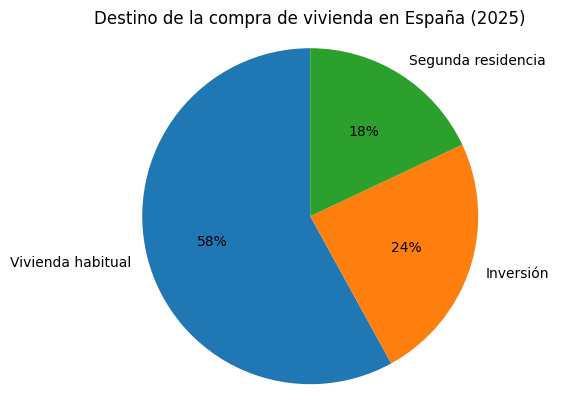
What was the purpose of buying property in 2025?
During 2025, the majority of transactions aimed to live in the property, not to invest.
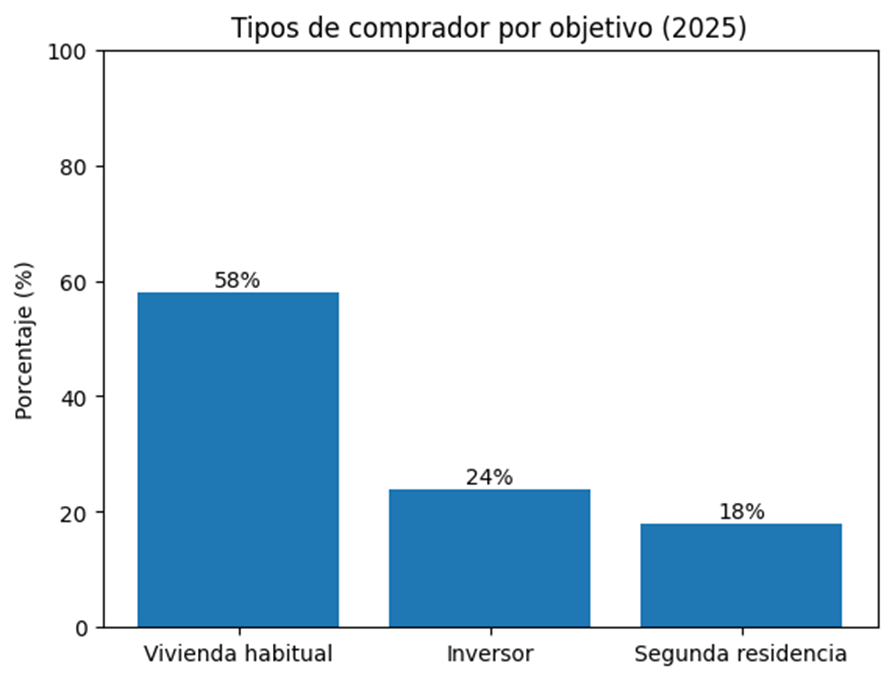
Approximate distribution of purchase purpose in 2025:
- Primary residence: ~55–60 %
- Investment: ~20–25 %
- Second home: ~15–20 %
Conclusion: the market remained predominantly residential, but with a growing share of purchases not linked to first homes.
2. HOW MANY BUYERS ALREADY OWNED PROPERTY IN 2025?
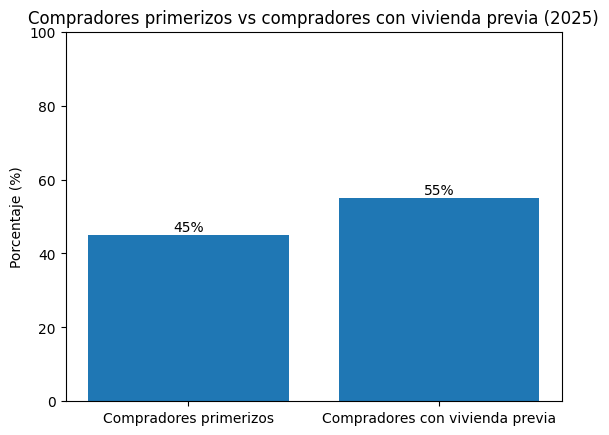
This was one of the most significant figures in the property market in 2025.
Over the year:
- Approximately 55 % of buyers already owned at least one property before purchasing.
- Only 45 % accessed ownership for the first time.
This does not mean that all owners sold in order to buy, but it did confirm that the average buyer in 2025 had more experience, assets and planning capacity than in previous cycles.
3. BUYERS WHO SOLD TO BUY: A RELEVANT REALITY IN 2025
It is important here to clarify the data correctly.
What the 2025 studies did show:
- Around 1 in 4 sellers put their property on the market with the explicit goal of buying another.
- This percentage remained high during 2025, though slightly below the peaks of previous years.
What the data does not allow us to say:
- There was no official statistic indicating that "half of the buyers" sold to buy.
- The correct term was to speak of a market with a strong component of home replacement, but not majority in absolute terms.
Professional interpretation:
During 2025, many buyers who were already owners:
- Sold first to free up capital
- Bought with less financing or no mortgage
- Or combined sale and bridge financing
This explained why transactions became increasingly complex and strategic.
4. INVESTOR BUYER IN 2025: ACTIVE AND MORE PROFESSIONAL
Investor buyers maintained a very relevant role during 2025, although with more selective behaviour:
- More profitability analysis
- Very specific areas
- Greater weight of own capital
- Less reliance on high financing
Estimated weight in 2025: between 20 % and 25 % of total buyers.
5. SECOND HOME: STABILITY DURING 2025
Second home buyers:
- Accounted for around 15–20 %
- Were concentrated in coastal and tourist areas
- Showed a middle-high income profile
- Combined personal use and possible rental
2025 was not the most dynamic segment, but did not lose relevance either.
6. FOREIGN BUYER: A PILLAR OF THE MARKET IN 2025
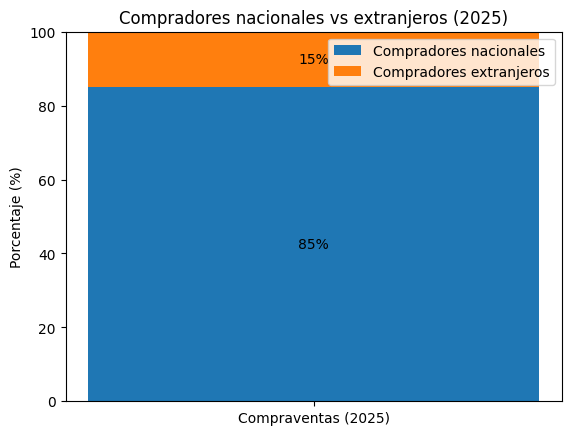
During 2025, foreign buyers:
- Represented approximately 14–15 % of total transactions
- Reached historic figures
- Were key in coastal areas, islands and large cities
Two clearly differentiated profiles:
- Resident foreigner
- Purchase of primary residence
- Frequent use of mortgage in Spain
- Non-resident foreigner
- Second home or investment
- Greater use of own funds
- Consolidated asset profile
7. AGE, INCOME AND FINANCIAL CAPACITY OF BUYERS IN 2025
Average age:
- Was between 40 and 45 years
- Purchases by those under 30 accounted for less than 10 %
Financial capacity:
- Higher prior savings
- Job stability
- Frequent use of assets or family support
This reinforced one clear conclusion:
In 2025, access to housing was increasingly linked to prior financial planning.
8. WHAT 2025 TAUGHT US: KEY INSIGHTS
- The first-time buyer lost relative weight.
- The market relied on buyers with prior assets.
- Selling to buy was a relevant strategy, but not majority.
- Investment remained very present, though more professionalised.
- The foreign buyer consolidated as structural.
- Each deal required more analysis and more financial strategy.
CONCLUSION
The profile of the homebuyer in Spain in 2025 was more mature, better informed, and financially more demanding. It was no longer just about finding a home, but about fitting the transaction into a coherent wealth and financial strategy..
Understanding who bought in 2025 is key to interpreting the current market and anticipating future decisions.
Because, as that year made clear, those who planned better bought better, not those who bought earlier..